

What are pelvic and acetabular fractures?
The pelvis is a ring of bone that carries your body weight from the spine into the legs. The acetabulum is the socket part of that ring, where the ball at the top of the thigh bone sits.
A pelvic ring fracture is a break in that ring. Because it is a ring, it often breaks in more than one place. How stable the injury is depends on which parts have broken and which ligaments have torn.
An acetabular fracture is a break into the hip socket itself. Because it involves a weight-bearing joint surface, the position the bone heals in matters a great deal for how the hip works afterwards.
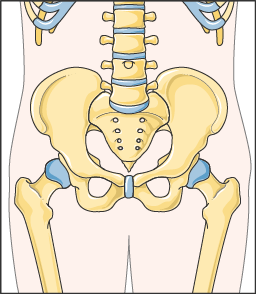
Pelvis, front view
The two hip bones and the sacrum meet to form a ring, which is why a break in one part of it so often comes with a second break elsewhere.
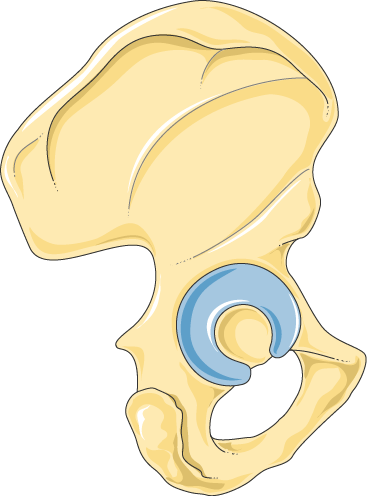
Hip bone and socket
The cup in the centre of the hip bone is the acetabulum. A fracture running into that surface is an acetabular fracture, and because it is part of a weight-bearing joint, how accurately it is restored matters.
How do these injuries happen?
There are two broad groups. High-energy injuries in younger people come from vehicle crashes, motorcycle and quad bike accidents, falls from height and crush injuries, and often occur with other injuries. Low-energy injuries in older people with weaker bone come from a simple fall. Both matter, and they are treated differently.
How are they assessed?
Assessment begins with X-rays and almost always includes a CT scan, which is what shows the fracture pattern in the detail needed to plan treatment. In acute high-energy injuries the first priority is always the whole patient, not just the fracture, and that is managed by the trauma team.
Classifying the injury accurately matters, because it determines whether the fracture is stable enough to be treated without surgery and, if surgery is needed, what operation to do.
How are they treated?
Some pelvic fractures are stable and are treated without surgery, with pain relief, protected weight bearing and monitoring, including repeat imaging to make sure the position holds.
Where surgery is needed, options include:
- Percutaneous fixation Screws or intramedullary implants placed through small incisions under imaging guidance to stabilise the ring.
- Open reduction and internal fixation The fracture is exposed, the bone put back into position and held with plates and screws. This is the usual approach for displaced acetabular fractures.
- External fixation Sometimes used early to stabilise an unstable pelvis.
- Fix and replace For some acetabular fractures, particularly in older patients with poor bone, the socket is fixed and a hip replacement performed at the same operation, rather than fixing it and waiting to see whether the hip survives. This is one of Dr Hoskins’ main research areas.
What does recovery involve?
Recovery from a pelvic or acetabular fracture is measured in months rather than weeks, and it usually involves a period of restricted weight bearing, then a graduated return under physiotherapy supervision. What is possible depends on the injury pattern, your other injuries and your general health, and it is discussed with you specifically. Some of these injuries lead to arthritis in the hip later, which may itself need treatment.
What research has Dr Hoskins published in this area?
This is Dr Hoskins’ most active trauma research area. His study on fracture stability in fix-and-replace surgery for acute acetabular fractures received a Highlight Award at the 2025 Orthopaedic Trauma Association Annual Meeting. He has published on anterior ring fixation constructs in lateral compression pelvic ring injuries, on a predictive scoring system for late displacement after non-operative treatment of these injuries, on acute total hip replacement for posterior wall acetabular fractures, and on a minimally invasive fixation device for anterior pelvic ring fractures. He also discussed fix-and-replace in acetabular fractures on the ConveyMD podcast.
Information for referrers
Referrals are accepted for acute pelvic ring and acetabular fractures, for late presentations and for the sequelae of earlier injuries including mal-union, non-union and post-traumatic arthritis. CT imaging is generally required for planning. See make a referral.