

What is revision knee replacement?
Revision knee replacement is surgery on a knee that has already been replaced. Some or all of the original components are removed and new ones are put in, often with additional fixation into the shaft of the bone, and sometimes with metal augments or cones to fill areas where bone has been lost.
It is a different operation from a first knee replacement, not a repeat of it.
The bone is already partly removed, the soft tissues have been operated on before, the ligaments may no longer be balanced, and the reason the first knee failed has to be understood and corrected rather than simply worked around.
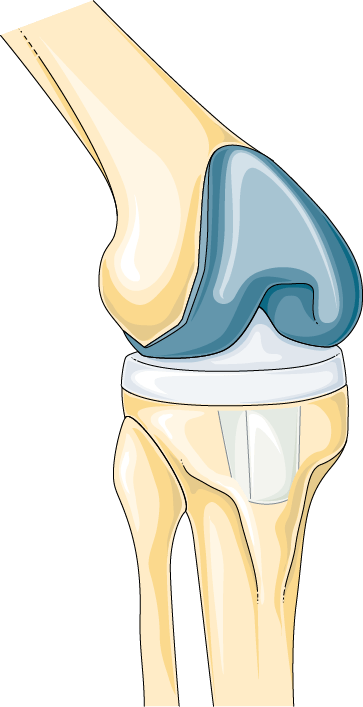
The illustration shows the components of a first knee replacement, which is where revision surgery starts.
A revision construct is not drawn here: it usually adds stems that reach down the shaft of the bone for fixation, more constraint between the components, and augments or cones where bone has been lost.
When is revision surgery needed?
The usual reasons a knee replacement needs revising are:
- Loosening. One or both components have lost their fixation to the bone.
- Wear. The plastic bearing has worn, sometimes with bone loss around it.
- Instability. The knee gives way or feels unreliable because the ligaments or the balance of the components are no longer holding it.
- Infection. Bacteria have colonised the implant. This may need staged surgery.
- Stiffness. The knee will not bend or straighten enough to function.
- Fracture around the implant. A periprosthetic fracture. See complex fracture problems.
- Ongoing pain with an identified cause. Pain on its own, without a cause that has been found, is not usually an indication for revision.
What does the assessment involve?
Working out why a knee replacement is failing is a substantial part of the job, and doing it properly changes what operation is done. Assessment usually includes a careful history and examination, plain X-rays and often further imaging, blood tests, and frequently a sample of fluid taken from the knee to test for infection. Records and operation notes from the original surgery are useful, so bring them or ask for them to be sent.
Revision surgery is only recommended once the cause is understood. Operating without knowing why the first knee failed risks repeating the same problem.
How is revision surgery different?
Revision cases are longer, more complex and less predictable than primary knee replacements. They typically use implants with more constraint, longer stems that engage the shaft of the bone, and sometimes metal cones or sleeves to reconstruct missing bone. If infection is present, treatment may be staged across two operations with a period of antibiotic treatment in between.
Recovery is generally slower than after a first replacement, and what can be achieved depends heavily on the state of the bone, the soft tissues and the reason for the failure. These are conversations to have individually rather than expectations to set from a website.
Why does subspecialty experience matter here?
Revision knee replacement is a low-volume, high-complexity area. Dr Hoskins completed a complex arthroplasty fellowship, co-authored the chapter on restoration of stability, joint line, gap balancing and constraint selection in Revision Total Knee Arthroplasty (Springer, 2024) with Kelly Vince, and co-authored a chapter on three-stage revision technique for a French Elsevier text in 2023. His research on technique and construct selection in aseptic revision knee replacement received the 2025 Surgical Techniques and Technologies Award from the American Association of Hip and Knee Surgeons.
Information for referrers
Referrals are welcome for painful, stiff, unstable or radiographically failing knee replacements, and for suspected periprosthetic joint infection. Where available, please include the original operation note and implant details, current weight-bearing X-rays, and inflammatory markers. See make a referral.