

Research and recognition
Dr Hoskins is an active clinical researcher as well as a practising surgeon, with over 80 peer-reviewed publications, five textbook chapters, two journal editorships and two 2025 awards from international professional bodies.
At a glance
The academic record
- Peer-reviewed publications
- 80+
- Textbook chapters
- 5
- Journal editorships
- 2
- Awards in 2025
- 2
- Competitive research grants
- 3
Spanning knee and hip arthroplasty, registry analysis, and pelvic and acetabular trauma.
Published by Springer, Elsevier, Wolters Kluwer, InTech and Oxford University Press.
Associate Editor at the Journal of Bone and Joint Surgery, and Deputy Editor for Adult Reconstruction and Trauma at EJOST.
From the American Association of Hip and Knee Surgeons, and the Orthopaedic Trauma Association.
From the Orthopaedic Trauma Association, AO Trauma North America and the Victorian Orthopaedic Research Trust.
Research focus
Dr Hoskins is an active clinician-researcher who focuses on clinically relevant questions in hip and knee arthroplasty and orthopaedic trauma, including revision joint replacement and the management of acetabular and pelvic fractures. He has authored more than 80 peer-reviewed publications, serves on the editorial boards of the Journal of Bone and Joint Surgery (JBJS) and the European Journal of Orthopaedic Surgery and Traumatology (EJOST), and his work has been recognised with international awards.
Why a surgeon’s research record matters to you
Orthopaedic practice changes. Which implant, which alignment, which approach, and when to operate at all are all questions the evidence keeps moving on. A surgeon who contributes to that evidence, and who reviews other surgeons’ work as a journal editor, is reading it closely rather than relying on how things were done during training.
Dr Hoskins’ research is not incidental to his practice.
Much of it is directly about the operations he performs: which knee replacement construct to use in a revision, whether adding a stem changes the risk of failure, how surgical approach relates to early revision in hip replacement, and how to stabilise a pelvic ring injury.
He has also published on equity of access to knee replacement for Māori and European patients in Te Tai Tokerau (Northland), and on whether a hard BMI cutoff for knee replacement restricts access without reducing revision risk. Both are research questions about who gets treated in this region.
2025
Awards from international professional bodies
-
2025
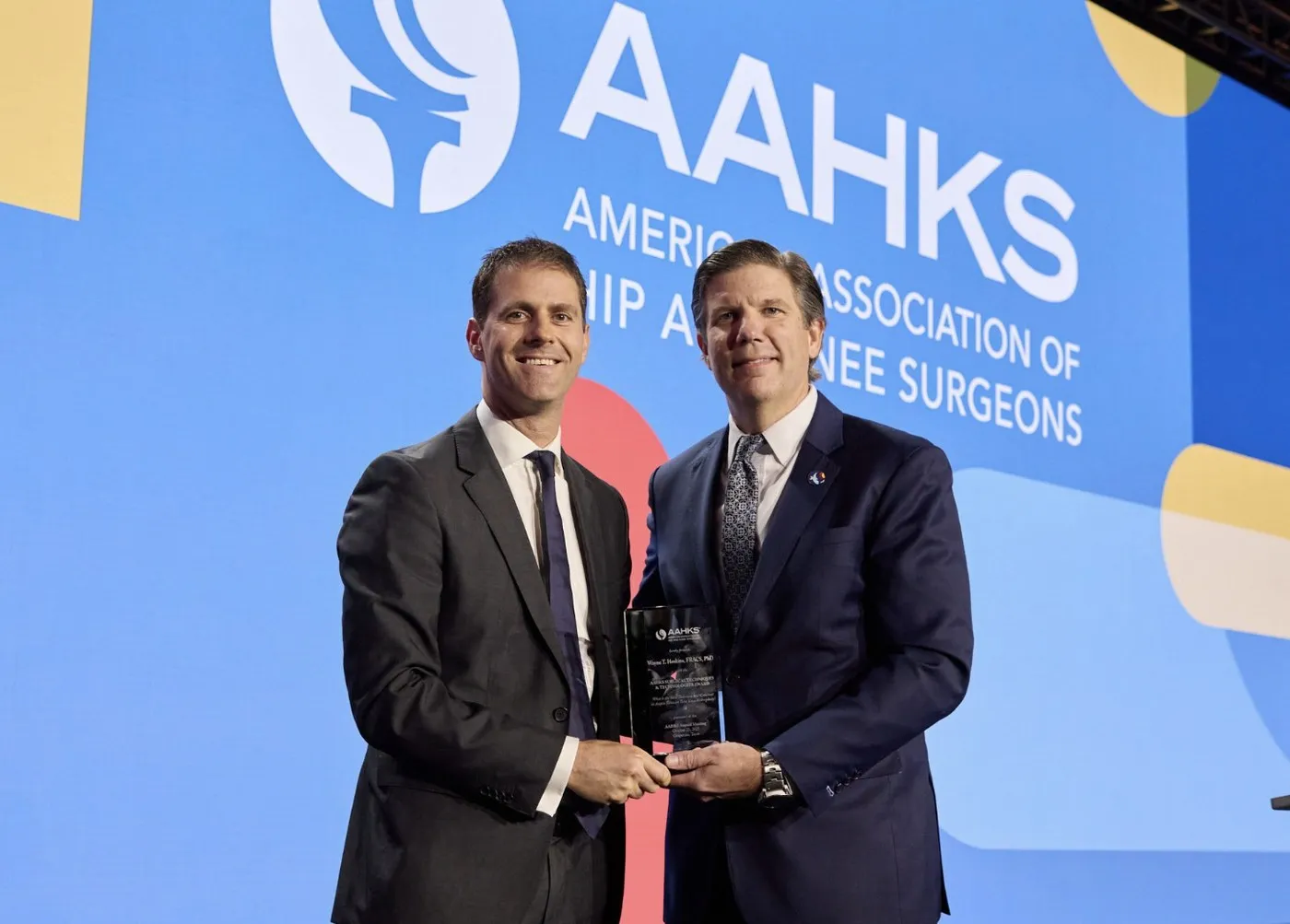
Surgical Techniques and Technologies Award
American Association of Hip and Knee Surgeons, for research on technique and construct selection in aseptic revision total knee replacement
-
2025
Highlight Award, Annual Meeting
Orthopaedic Trauma Association, for research on fracture stability in fix-and-replace surgery for acute acetabular fractures
Peer review
Editorial appointments
- Associate Editor
- Journal of Bone and Joint Surgery · 2025 – present
- Deputy Editor, Adult Reconstruction and Trauma
- European Journal of Orthopaedic Surgery and Traumatology · 2025 – present
- New Zealand AO Trauma Asia Pacific NextGen Local Lead
- AO Trauma Asia Pacific · 2026 – present
- Clinical Senior Lecturer
- University of Melbourne · 2022 – present
Funding
Research grants
-
2025
Orthopaedic Trauma Association
US$20,000, principal investigator. Developing a decision-making tool for total hip replacement versus hemiarthroplasty in femoral neck fracture, based on predicted five-year mortality
-
2024
AO Trauma North America Fellows Research
Co-investigator. A prospective longitudinal cohort study of lateral compression pelvic ring fractures with continuous activity measurement
-
2017
Victorian Orthopaedic Research Trust
NZ$9,780, principal investigator. Biomechanical stability of fracture reduction and cerclage wire augmentation in reverse oblique proximal femur fractures
Focus
Main areas of research
-
Knee replacement alignment and phenotype
How component alignment, the natural shape of a knee, constraint and bearing choice relate to how long a knee replacement lasts. This is the area that received the 2025 AAHKS Surgical Techniques and Technologies Award.
Related pages -
Revision knee and hip replacement
Technique and construct selection in aseptic revision knee replacement, and revision hip replacement for instability, including dual mobility constructs and constrained liners.
Related pages -
Pelvic and acetabular trauma
Fixation constructs in lateral compression pelvic ring injuries, prediction of late displacement, and fix-and-replace surgery for acute acetabular fractures. Recognised with a Highlight Award at the 2025 OTA Annual Meeting.
Related pages -
Registry analysis and methodology
Large-scale analysis of national joint replacement registry data from Australia and New Zealand, and work on what registries fail to collect, alongside methodological papers on causal inference from observational data.
Related pages
The full record
Peer-reviewed publications and textbook chapters
The publications page lists 77 published and accepted peer-reviewed papers and 5 textbook chapters, grouped by year.
Reading the full papers
Each publication links either to the journal’s DOI record or to Dr Hoskins’ ResearchGate profile, where a copy is usually available. Full text PDFs are hosted here only where the journal’s policy or an open-access licence permits it, so some papers will open on the publisher’s own site rather than as a download.
Patient information
What to expect after joint replacement
Both operations replace the worn joint surfaces with implant components, to relieve arthritic pain and restore movement. Recovery is gradual over months, and implants commonly last many years, though not forever.
Total knee replacement
Total hip replacement
Hospital stay
Total knee replacement
About 1 to 4 nights
Total hip replacement
About 1 to 2 nights
Physiotherapy
Total knee replacement
From day 1, continuing for about 2 months or more
Total hip replacement
From day 1, continuing for about 2 months or more
Walking aids
Total knee replacement
Crutches or a frame early on, reduced as you progress
Total hip replacement
Crutches or a frame early on, reduced as you progress
Driving
Total knee replacement
Often about 4 to 6 weeks, once safe and off strong pain relief
Total hip replacement
Often about 4 to 6 weeks, once safe and off strong pain relief
Swelling settles
Total knee replacement
About 3 to 6 months
Total hip replacement
About 3 to 6 months
High impact activity
Total knee replacement
Running is generally discouraged
Total hip replacement
Running is generally discouraged
These are typical ranges only, not a guarantee. Your surgeon will advise what to expect in your case. As with any surgery, joint replacement carries risks, which are discussed with you in detail before you decide.
Discuss your knee, hip or fracture with Dr Hoskins
Appointments are made by referral from your GP or another health professional. If you are unsure whether a referral is the right next step, the rooms can talk you through it.