

What is a hip replacement?
The hip is a ball-and-socket joint. In arthritis, the cartilage lining both the ball at the top of the thigh bone and the socket in the pelvis wears away. A hip replacement removes the worn ball and replaces it with a smooth head on a stem fixed into the thigh bone, and lines the socket with a new cup. The two surfaces that then articulate may be metal, ceramic or hard plastic in various combinations.
It is often called a total hip replacement, a total hip arthroplasty or a THA. Components can be fixed to bone with cement or press-fitted so that bone grows onto them, and the choice depends on your bone quality, your age and the shape of your anatomy.
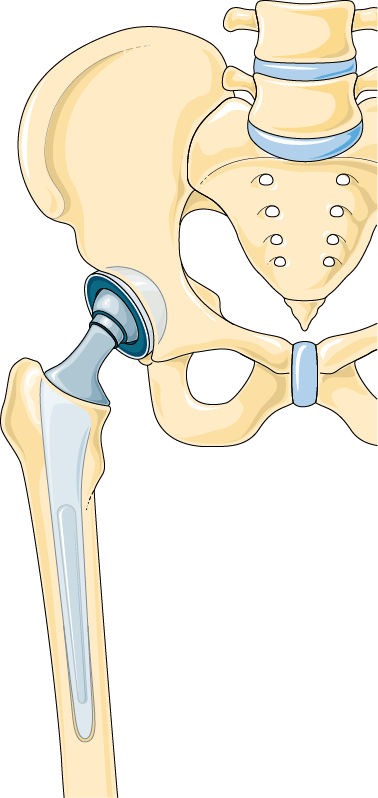
The worn ball at the top of the thigh bone has been removed and replaced with a smooth head on a stem set into the bone, and the socket in the pelvis has been lined with a cup. The head moves against the cup in place of the worn cartilage.
Who is a hip replacement considered for?
Replacement is considered when arthritis is advanced on imaging, it is meaningfully affecting your life, and non-surgical treatment is no longer controlling it.
Common indicators include:
- Groin pain on walking, or pain that has started waking you at night
- Difficulty putting on shoes and socks, or cutting your toenails
- A limp, or shortening of the leg
- Reduced walking distance and reliance on a stick
- Limited benefit from exercise, physiotherapy, weight management or pain relief
Hip replacement is also used to treat some hip fractures, avascular necrosis (where the blood supply to the femoral head has failed), and arthritis arising from childhood hip conditions or previous injury.
What happens before surgery?
Planning includes imaging to template the size and position of the components, and a pre-admission assessment at the hospital covering your general health, medications and anaesthetic fitness. Blood thinners and some other medications need to be managed in advance. See preparing for surgery.
What does recovery involve?
You will be helped up and walking with support soon after surgery. Most people use crutches or a frame at first and progress as comfort and confidence allow. Physiotherapy guides that progression.
How quickly you recover depends on your age, general health, how limited you were beforehand and what you are returning to. Any precautions about hip position, driving, or returning to work depend on the approach used and your individual circumstances, and will be explained to you directly rather than assumed from a website. See after your surgery.
What are the risks?
Hip replacement is major surgery. The risks discussed as part of consent include infection, blood clots, dislocation of the new joint, leg length difference, fracture of the bone around the implant, nerve or blood vessel injury, wear or loosening over time, and the possibility of further surgery. Anaesthetic carries its own risks.
Your individual risk depends on your health, your anatomy and other factors, and is discussed with you before you consent. A hip replacement does not last forever; if one fails, see revision hip replacement.
How does research inform this operation?
A large part of Dr Hoskins’ published work is on hip replacement, much of it analysing national joint replacement registry data from Australia and New Zealand. It covers how surgical approach relates to early revision and complications, how femoral head size and acetabular component size affect dislocation and revision, dual mobility and constrained liners, cemented and cementless stem selection and surface finish, and hip replacement versus hemiarthroplasty after a femoral neck fracture. Several of these papers are in the Journal of Bone and Joint Surgery and Clinical Orthopaedics and Related Research.
See the publications page for the full list.