

What is a knee replacement?
In an arthritic knee, the smooth cartilage that covers the ends of the bones has worn away, so bone rubs against bone. A knee replacement removes the damaged surfaces and caps them with new ones: a metal component on the end of the thigh bone, a metal component on the top of the shin bone, and a hard-wearing plastic bearing between them. The back of the kneecap may also be resurfaced.
The operation is often called a total knee replacement, a total knee arthroplasty or a TKA. The aim is to address the pain and loss of function caused by arthritis.
It does not give you the knee you had at twenty, and it is not a decision to be made lightly.
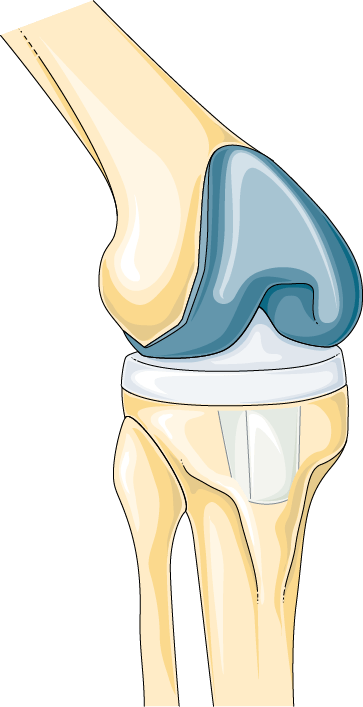
The metal component caps the end of the thigh bone, a second component sits on the cut surface of the shin bone, and the plastic bearing between them takes over from the cartilage that has worn away.
The bones themselves are kept; only the damaged surfaces are replaced.
Who is a knee replacement considered for?
Knee replacement is considered when the arthritis is advanced on imaging, when it is causing symptoms that meaningfully affect your daily life, and when non-surgical treatment is no longer controlling those symptoms. Typically that means some combination of:
- Pain that disturbs your sleep or is present at rest, not only on activity
- Difficulty with stairs, getting out of a chair, or walking the distances you need to
- Stiffness or deformity of the knee that is getting worse
- Limited benefit from weight management, exercise, physiotherapy, pain relief or injections
Being a candidate for surgery is a separate question from whether surgery is the right choice for you now. That is what the consultation is for. Some people are better served by continuing non-surgical treatment for a period, and that is a legitimate outcome of an appointment. See knee arthritis for what comes before surgery.
What happens before surgery?
If you and Dr Hoskins decide to proceed, you will have:
- A planning appointment
- Imaging
- A pre-admission assessment at the hospital, to check that you are fit for the anaesthetic
Existing medical conditions, medications and blood thinners all need to be reviewed and sometimes adjusted in advance.
There is also work you can do yourself in the weeks beforehand. The preparing for surgery page covers this in detail.
What does recovery involve?
You will be helped to stand and walk with support soon after surgery, usually the same day or the day after. Physiotherapy starts in hospital and continues after you go home, and the work you put into it matters. Regaining movement and strength in a new knee is an active process, not something that happens on its own.
Recovery timeframes differ considerably from person to person, depending on your age, your general health, how stiff the knee was beforehand and what you need to get back to. Dr Hoskins will talk through what is realistic in your situation rather than quoting an average. The after your surgery page covers the general shape of the recovery.
What are the risks?
Knee replacement is major surgery and it carries risk. The risks that are discussed as part of consent include infection, blood clots, stiffness, ongoing pain, nerve or blood vessel injury, fracture around the implant, wear or loosening of the components over time, and the possibility of needing further surgery. Anaesthetic itself carries risk.
Your own risk depends on your health, your weight, whether you smoke, the state of the knee and other factors. These are discussed individually before you consent to surgery, not summarised in a number on a website.
A knee replacement does not last forever. If one wears, loosens, becomes unstable or becomes infected, further surgery may be needed. See revision knee replacement.
How does research inform this operation?
Dr Hoskins’ published research is concentrated in this area, drawing on national joint replacement registry data. It covers how component alignment affects how long a knee replacement lasts, how the natural shape of a knee (its phenotype) should influence the plan, when a stem or a more constrained bearing is warranted in a deformed knee, and how alignment philosophies compare in randomised trials. He was awarded the 2025 Surgical Techniques and Technologies Award by the American Association of Hip and Knee Surgeons.
The publications page lists this work in full.