When a fracture does not go to plan
Most fractures heal. Some do not, or heal in a position that leaves a lasting problem, and those cases need a different kind of thinking from an acute fracture. This is the area Dr Hoskins’ fellowship at the University of Missouri in orthopaedic trauma and advanced reconstruction covered: limb salvage, correction of non-unions, and the management of post-traumatic deformity and infection.
These are often the referrals that have already been somewhere else. Second opinions and referrals from other surgeons are welcome.
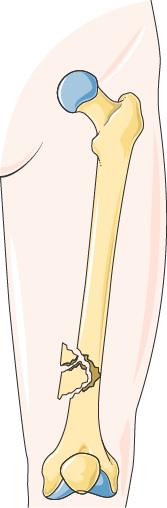
Comminuted fracture
Injuries like this disturb the blood supply around the bone as well as its structure, and both matter to healing, which is part of why some fractures are more demanding to treat than others.
Delayed union and non-union
Delayed union means a fracture is healing more slowly than expected. Non-union means it has stopped healing altogether. The usual signs are ongoing pain at the fracture site well beyond the expected healing time, pain on weight bearing or use, and X-rays that are not changing.
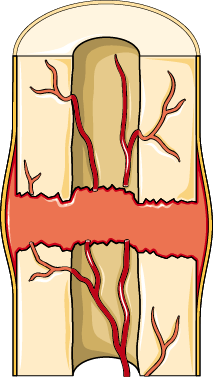
How a fracture heals
Blood supply to the injured ends brings the cells that lay down soft new tissue, which is replaced by bone and then slowly remodelled.
Delayed union means that sequence is running behind time. Non-union means it has stalled, and the point of the assessment is to work out which step is being blocked and why.
Working out why is the first task, and there is usually more than one reason. Contributors include inadequate stability at the fracture, poor blood supply, a gap between the bone ends, infection, smoking, diabetes, some medications, and nutritional or vitamin D deficiency.
Treatment is directed at the cause and may involve:
- Improving stability with revised or different fixation
- Bone graft or a bone graft substitute to fill a gap and stimulate healing
- Removing dead or infected bone before reconstruction
- Treating infection, sometimes in stages
- Addressing the modifiable factors: smoking, blood sugar control, nutrition, medications
Mal-union and deformity
Mal-union means the fracture has healed, but in the wrong position. The bone may be angled, rotated, or shorter than the other side. This can cause a limp, a leg length difference, altered loading of the joints above and below, and pain that develops over time rather than immediately.
Correction usually involves an osteotomy: the bone is deliberately cut, realigned into the correct position and held with plates, screws, a nail or an external frame while it heals. The planning is detailed and generally requires CT and full-length alignment imaging. Not every mal-union needs correcting, and part of the assessment is deciding whether it should be.
Fractures around a joint replacement
A periprosthetic fracture is a break in the bone around an existing hip or knee replacement, usually after a fall. These sit between two specialties, because the decision is not only how to fix the fracture but whether the implant is still well fixed.
If the implant is stable, the fracture is usually fixed around it with plates, screws or a nail. If the implant has loosened, the right operation is often to revise the joint replacement at the same time, using longer components that bypass the fracture.
Getting that decision right the first time matters, because a fixation that fails leaves a harder problem behind.
See revision hip replacement and revision knee replacement.
Bone and joint infection
Infection can follow an open fracture, fracture surgery or joint replacement. It is listed separately in Dr Hoskins’ areas of expertise and he is a member of the Musculoskeletal Infection Society. Treatment usually combines surgery to remove infected tissue and, where necessary, the implant, with a course of antibiotics guided by microbiology and often staged over more than one operation.
What does treatment involve?
These are individual problems and they do not follow a standard pathway. Treatment is often longer and staged, and expectations are set case by case after the cause is understood. What can be achieved depends on the bone, the soft tissues, whether infection is present and your general health.
Information for referrers
Referrals are welcome for fractures failing to progress, established non-union and mal-union, post-traumatic deformity, periprosthetic fracture, and suspected fracture-related or periprosthetic infection. Please include the original operation notes and implant details where available, the imaging sequence from injury to date, and inflammatory markers. See make a referral.