

What is revision hip replacement?
Revision hip replacement is surgery on a hip that has already been replaced. Depending on what has gone wrong, it may involve exchanging only the bearing surfaces, replacing the socket component, replacing the stem, or replacing everything and reconstructing bone that has been lost.
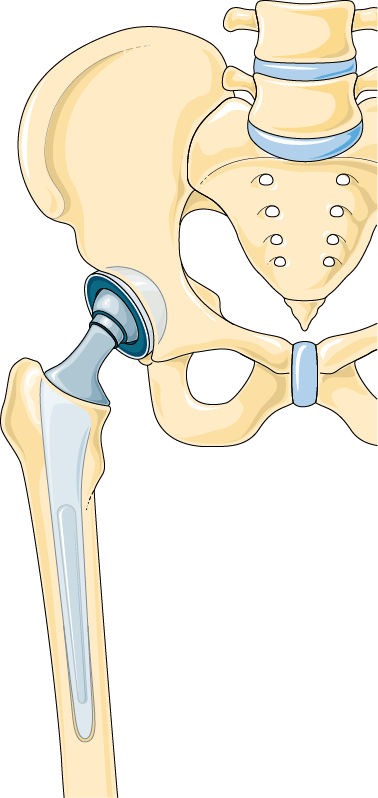
The stem sits inside the thigh bone and carries the head, and the cup is fixed into the socket of the pelvis. The bearing surfaces are where the head and the cup meet.
A revision may exchange only the bearings, the cup or the stem alone, or all of them together with reconstruction of lost bone.
The operation is planned around the specific reason the first hip failed.
Two revisions for different causes can be entirely different procedures.
Why do hip replacements fail?
- Loosening The socket, the stem or both have lost fixation to the bone. This is the most common long-term reason for revision.
- Instability and recurrent dislocation The hip comes out of joint repeatedly. Treatment depends on why, which may be component position, soft tissue laxity, impingement or muscle weakness.
- Wear of the bearing surfaces Sometimes with bone loss around the implant.
- Infection Bacteria have colonised the implant, which usually requires staged surgery combined with antibiotic treatment.
- Fracture around the implant Periprosthetic fracture, often after a fall. See complex fracture problems.
- Fracture of a ceramic bearing Uncommon, but requires prompt treatment.
How is a failing hip replacement assessed?
The assessment sets out to establish the cause, because operating without knowing why the first hip failed risks repeating it. It generally includes a history and examination, plain X-rays and often CT or other imaging, blood tests including inflammatory markers, and frequently a sample of joint fluid to exclude infection. The original operation note and implant details are very useful, so bring them or ask for them to be sent.
Pain after a hip replacement is not always coming from the hip. The spine, the other hip, and tendon problems around the hip are all common alternative sources, and part of the assessment is ruling them in or out.
What does revision surgery involve?
Revision cases take longer, involve more blood loss and are less predictable than a first hip replacement. They may use longer or differently fixed stems, larger or augmented sockets, bone graft, and bearing options chosen specifically to address instability, such as dual mobility constructs or constrained liners. Where infection is present, treatment is often staged over two operations with antibiotics in between.
Recovery is usually slower than after a first replacement, and what can be achieved depends on the state of the bone and soft tissues and the reason for failure. These expectations are set individually.
What research has Dr Hoskins published in this area?
Dr Hoskins has published on revision hip replacement for instability, comparing standard, large head, dual mobility and constrained liner options in over 1,200 revision hips, on re-revision risk with dual mobility versus large femoral head bearings, on revision for aseptic loosening of highly porous acetabular components, and on outcomes of hip hemiarthroplasty revised to total hip replacement. This work is in the Journal of Bone and Joint Surgery, Clinical Orthopaedics and Related Research and the Journal of Arthroplasty, and is listed on the publications page.
Information for referrers
Referrals are welcome for painful, loose or unstable hip replacements, recurrent dislocation, suspected periprosthetic joint infection and periprosthetic fracture.
Where available, please include the original operation note and implant details, current X-rays including the whole implant, and inflammatory markers. See make a referral.