

If you have just been injured
For an open fracture, severe deformity, a suspected broken hip, multiple injuries, or a limb that is cold or losing circulation, call 111 or go to Whangārei Hospital Emergency Department.
Do not wait for an appointment.
For an injury that is urgent but stable, a GP, physiotherapist, urgent care clinic or emergency department can phone the rooms on 027 555 5210 to arrange early assessment. Recent imaging helps considerably, so an X-ray first means you are seen sooner.
If the injury was an accident, it is generally covered by ACC. The person who first sees you, whether that is a GP, physiotherapist, emergency department or radiology service, usually lodges the claim. Bring the claim number if you already have one.
Trauma is a distinct part of this practice
Orthopaedic trauma is not a sideline here. Three of Dr Hoskins’ four post-fellowship subspecialty fellowships were in trauma: pelvic, acetabular and complex trauma at the Royal Adelaide Hospital, AO Trauma at the R Adams Cowley Shock Trauma Center in Maryland, and orthopaedic trauma and advanced reconstruction at the University of Missouri. He is the New Zealand AO Trauma Asia Pacific NextGen Local Lead.
That training covers acute fractures across the body, injuries to the pelvic ring and the hip socket, and the harder problems that follow an injury: fractures that have not healed, have healed in the wrong position, have become infected, or have happened around an existing joint replacement.
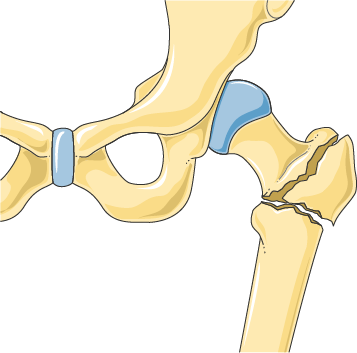
This is what is usually meant by a broken hip. Where a fracture runs, how many pieces it is in and how close it sits to the joint surface all change what the surgery has to do.
What Dr Hoskins treats
- Acute fractures across the body, including complex and multi-injury cases
- Pelvic ring and acetabular (hip socket) fractures
- Fractures around an existing hip or knee replacement
- Fractures that have not healed (delayed union and non-union)
- Fractures that have healed in the wrong position (mal-union and deformity)
- Bone and joint infection following injury or surgery
- Joint replacement performed at the time of, or after, a fracture
The joint replacement side of the practice matters here.
A fracture that runs into a worn joint, or into an existing hip or knee replacement, is a problem of both fixation and reconstruction, and it is treated by the same surgeon rather than split between two.
What to refer elsewhere
Trauma referrals move quickly, so it helps if they arrive in the right place first time. Acute fractures anywhere in the body are accepted, including in the regions below. What Dr Hoskins does not routinely take is the elective work in them.
- Spine
- Shoulder, elbow, wrist and hand, elective
- Foot and ankle, elective
- Paediatric orthopaedics
- Elective arthroscopy and sports soft-tissue reconstruction
- Hip preservation
The for referrers section sets out the full list, what is useful in a referral, and how to send one.
Research in trauma
Dr Hoskins researches this area actively. His work on fracture stability in fix-and-replace surgery for acute acetabular fractures received a Highlight Award at the 2025 Orthopaedic Trauma Association Annual Meeting, and he holds a US$20,000 Orthopaedic Trauma Association grant as principal investigator on a decision-making tool for hip fracture surgery. He has published on pelvic ring fixation, patella fractures, tibial plateau fractures, distal femur fractures and cerclage wire technique in proximal femur fractures. The full list is on the publications page.
Getting seen after an injury
A trauma referral works differently from an elective one, and it is usually urgent. If you have been to an emergency department or another hospital and been told you need specialist review, ask the treating team to send a referral directly. GPs and physiotherapists can also refer. The make a referral page sets out how.
If you have a new injury and have not yet been assessed, go to your GP, an accident and medical clinic, or an emergency department first. If it is an emergency, call 111.